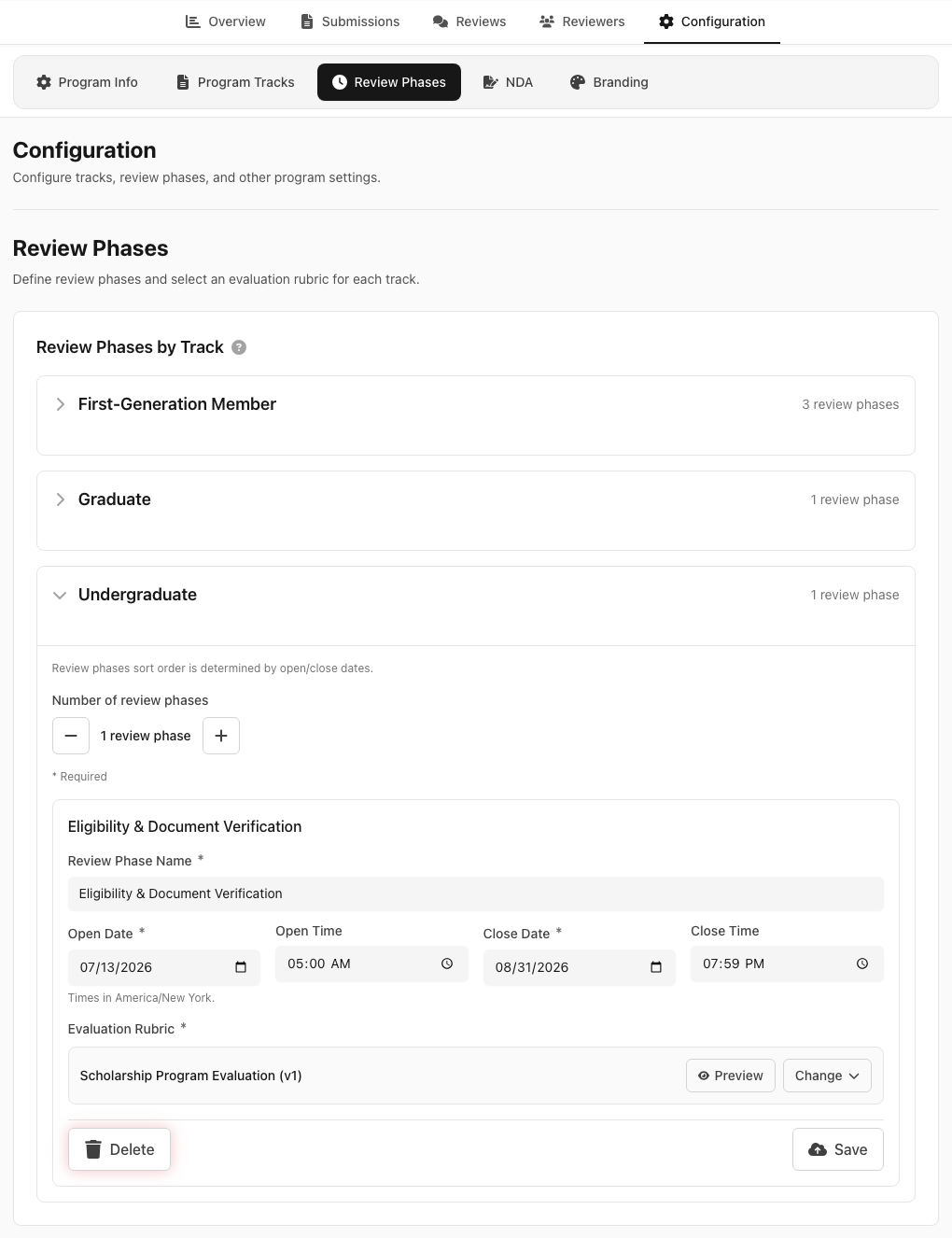
Document-Driven Eligibility
Verify transcripts, recommendations, and supporting documents with documented rationale before applications advance to committee review.
From application through eligibility verification to award announcement, scholarship programs need structure that holds up to scrutiny. The platform handles document verification, multi-phase committee review, and a full audit trail without spreadsheets or manual coordination.
Scholarship programs begin with structured applications and document verification. Staff can require documented rationale for ineligible applications before they move into review.
Applications progress through defined review phases with assigned scoring rubrics and controlled evaluation windows. Reviewers work within their assigned scope. Advancement happens only after required reviews are completed.
Once reviews are submitted, phase configuration locks to preserve the integrity of evaluation and award decisions.
The result is fair evaluation, defensible awards, and no manual coordination behind any of it.
Scholarship programs move through clearly defined stages. From application intake to eligibility verification and committee selection, each step builds on the one before.
Staff keep oversight. Reviewers work within their assigned scope. Decisions move forward only when the criteria are met.
From application intake to final award decision, every application moves through structured forms, documented eligibility verification, and controlled review phases. Review activity is time-bound and rubric-driven. Advancement is controlled by phase logic, not manual coordination. The result is a process you can defend, cycle after cycle.
Verify transcripts, recommendations, and supporting documents with documented rationale before applications advance to committee review.
Coordinate committee reviewers per phase. Control access, manage conflicts of interest, and enforce evaluation windows.
Award recommendations progress only when required reviews are complete. Final award decisions are made within a governed workflow. All decisions are recorded and traceable.
Scholarship programs carry reputational weight. They need more than a way to collect applications. They need fairness, stewardship, and continuity.
Every application is evaluated against the same rubric. Multiple committee members review each one, with scores and rationale recorded for every decision.
Every eligibility decision, review, score, and award is recorded. Audit trails protect the integrity of the outcome when donors and boards ask questions.
Reuse rubrics, eligibility criteria, and application forms without rebuilding each cycle. Each cycle builds on the last instead of starting from scratch.
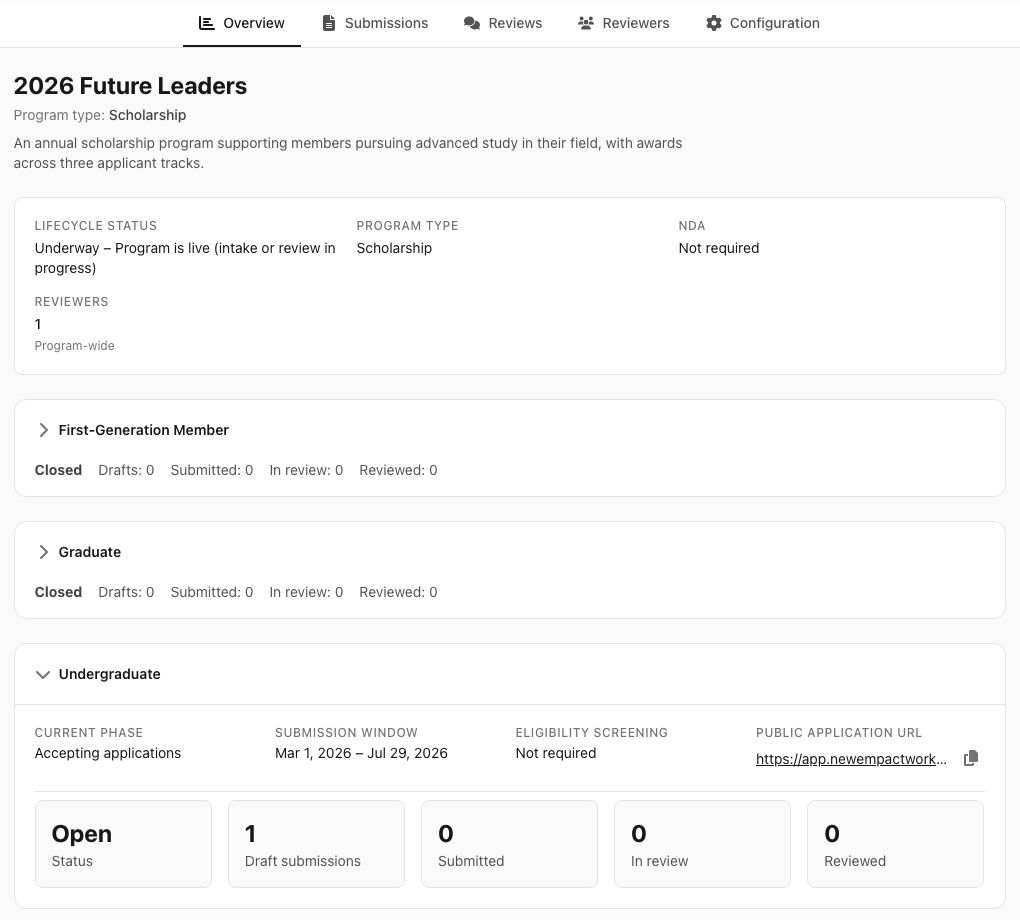
Run scholarship programs that stand up to scrutiny, cycle after cycle.